Is the laptop short of RAM or slow for another reason?
RAM holds the information applications are actively using. Storage holds your files and installed software. Buying a larger SSD does not add RAM, and adding RAM does not automatically fix a slow or failing SSD. The two upgrades answer different problems.
Watch the laptop during the task that causes trouble. Open Task Manager and compare Memory, CPU and Disk activity while your usual applications are running. A brief spike is different from repeated pressure that coincides with stuttering or application switching. Close one demanding application and see whether the behaviour changes.
These observations are clues, not a complete performance diagnosis. For a laptop that is slow even with little open, start with our slow-laptop diagnosis guide. Kingston's memory assessment guidance also treats capacity as a question of workload rather than a single number suitable for everybody.
How to think about 8GB, 16GB and 32GB
The following is a practical planning framework, not a claim that a particular capacity guarantees performance. Software requirements change, and two people using the same browser can have very different workloads.
| Capacity to assess | Workload example | Question before buying |
|---|---|---|
| 8GB | Light browsing, email and a small number of documents | Does the real workload already run out of memory? |
| 16GB | Several everyday apps, calls and a larger browser session | Is this enough headroom for the apps you actually use? |
| 32GB | Heavier editing, development, virtual machines or large projects | Do the tools and project sizes justify it? |
| Above these levels | Specialist workloads | Can the laptop support it, and will CPU or graphics still limit the task? |
There is no benefit in buying the largest option simply to make a repair quote sound better. Equally, upgrading just enough to remain constantly constrained can be poor value. Check the software maker's recommendations and leave sensible room for the workload, rather than relying only on minimum installation requirements.
Can this particular laptop be upgraded?
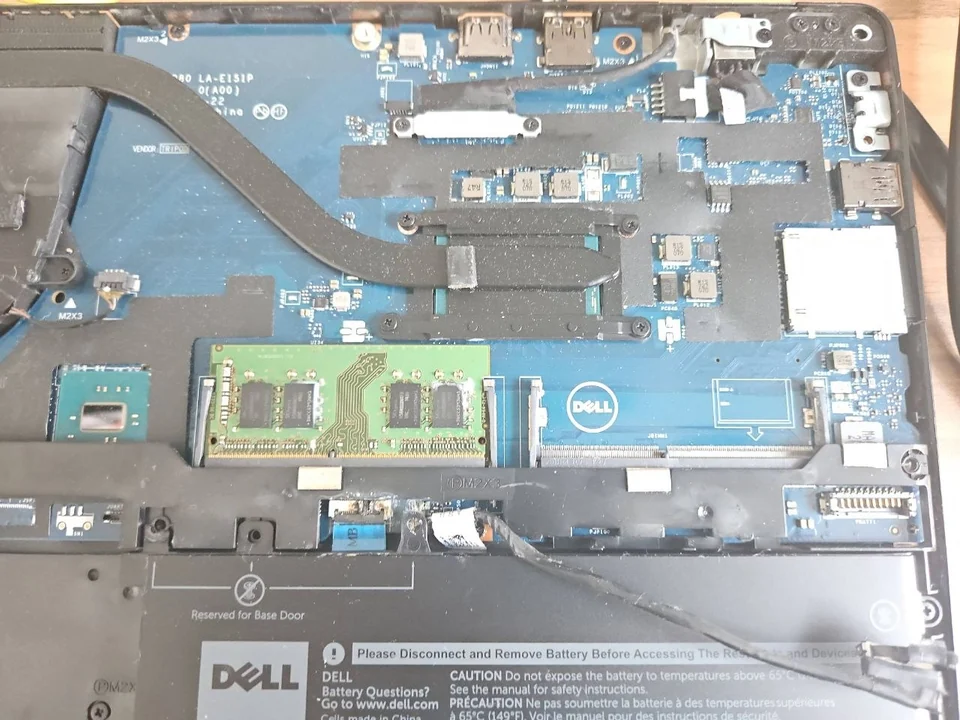
Check the complete model or product number. Marketing names can cover several board configurations. Some machines have removable modules, some combine soldered memory with a slot, and others have no replaceable RAM at all. A specification listing a maximum factory configuration is not necessarily an upgrade promise for the laptop you own.
Confirm the supported memory generation, form factor, capacity and any manufacturer restrictions. DDR generations are not interchangeable. Do not assume every laptop uses the same removable module style or that a visible spare position can accept any capacity.
Task Manager can provide useful starting information, but the service manual and compatible part specification are the safer basis for ordering. Our computer upgrade service in Birmingham checks this before recommending a purchase.
Will mixing memory modules cause problems?
The supported configuration matters more than simply matching the number printed in a listing. Capacity, generation, operating specifications and the laptop's design affect compatibility. A system may run compatible modules at a common supported setting rather than the highest advertised speed.
Balanced configurations can affect memory bandwidth on some designs, but this is not a promise that a particular pairing will double application speed. Ask what is currently installed, what will be added or replaced, and how the finished configuration will be tested. Keep the original module until the upgrade is confirmed stable.
Installation should follow the exact service procedure, including battery isolation where required. Do not open a sealed laptop just to discover that its RAM cannot be changed.
When an SSD upgrade or repair is the better route
A machine with adequate memory may be waiting on slow storage, struggling with a background task or reducing speed because of heat. A new RAM module will not repair those causes. The SSD upgrade guide explains when storage changes are relevant, while the laptop overheating guide covers performance that drops after warming up.
Memory capacity and memory failure are also different. Crashes and diagnostic memory errors should be investigated as faults, not treated as evidence that the laptop simply needs more gigabytes. Dell's memory troubleshooting guidance separates diagnostic, hardware and software causes.
What should an upgrade quote include?
A useful quote identifies the existing configuration, proposed part, supported total capacity and labour. It should also say whether old modules are being replaced and returned. Ask how the laptop will be checked after fitting: recognition of the intended capacity, memory testing and the original workload all matter.
Back up important files before any internal work. A RAM upgrade is not intended to erase storage, but a backup still protects against unrelated problems. It is also worth weighing the upgrade against the laptop's other limitations using our repair-or-replace guide.
Bring the laptop and details of the work that feels slow to PC Repair Guru. The decision should be based on compatibility and an identifiable limit, not a promise that every 8GB machine becomes fast by adding memory.
Frequently asked questions
Will 32GB make my laptop twice as fast as 16GB?
Not automatically. Extra capacity helps when the workload needs it. If the laptop already has enough memory, the processor, graphics, storage, software or cooling may be the limiting factor instead.
Can every 8GB laptop be upgraded to 16GB?
No. Some have soldered memory or capacity restrictions. Confirm the exact model's service information and compatible configuration before ordering parts.
Is RAM or an SSD the better upgrade?
They solve different constraints. Assess memory pressure and storage behaviour during the slow task. A diagnosis is more useful than recommending either upgrade from the laptop's age alone.